


Colosseum
By Aysegul Liman Kaban
At the end of the lesson learners will be able to:
- Identify what the Colosseum was used for in Ancient Rome.
- Describe key facts about the Colosseum’s structure and capacity.
- Explain how entertainment in Ancient Rome was different from today.
- Create a fact card about the Colosseum.
Standards
Irish Primary History Curriculum (SESE – History, 2023)
- Strand: Life, Society, Work and Culture in the Past.
- Strand Unit: Romans → Explore buildings, culture, and everyday life.
- SB.4.2.1: Tarihte önemli uygarlıkları ve eserlerini tanır.
- SB.4.2.2: Kültürel mirasın korunmasının önemini kavrar.
Teaching materials
- Colosseum fact sheet
- Map of Ancient Rome (Augmented Activity)
- Visuals (Augmented Activity)
- Video (Augmented Activity)
- Worksheet: Fill in the blanks & “True or False” facts about the Colosseum
Steps
Introduction
Introduction (5 minutes)
- Teacher question: “Have you ever been to a stadium to watch football or a concert?”
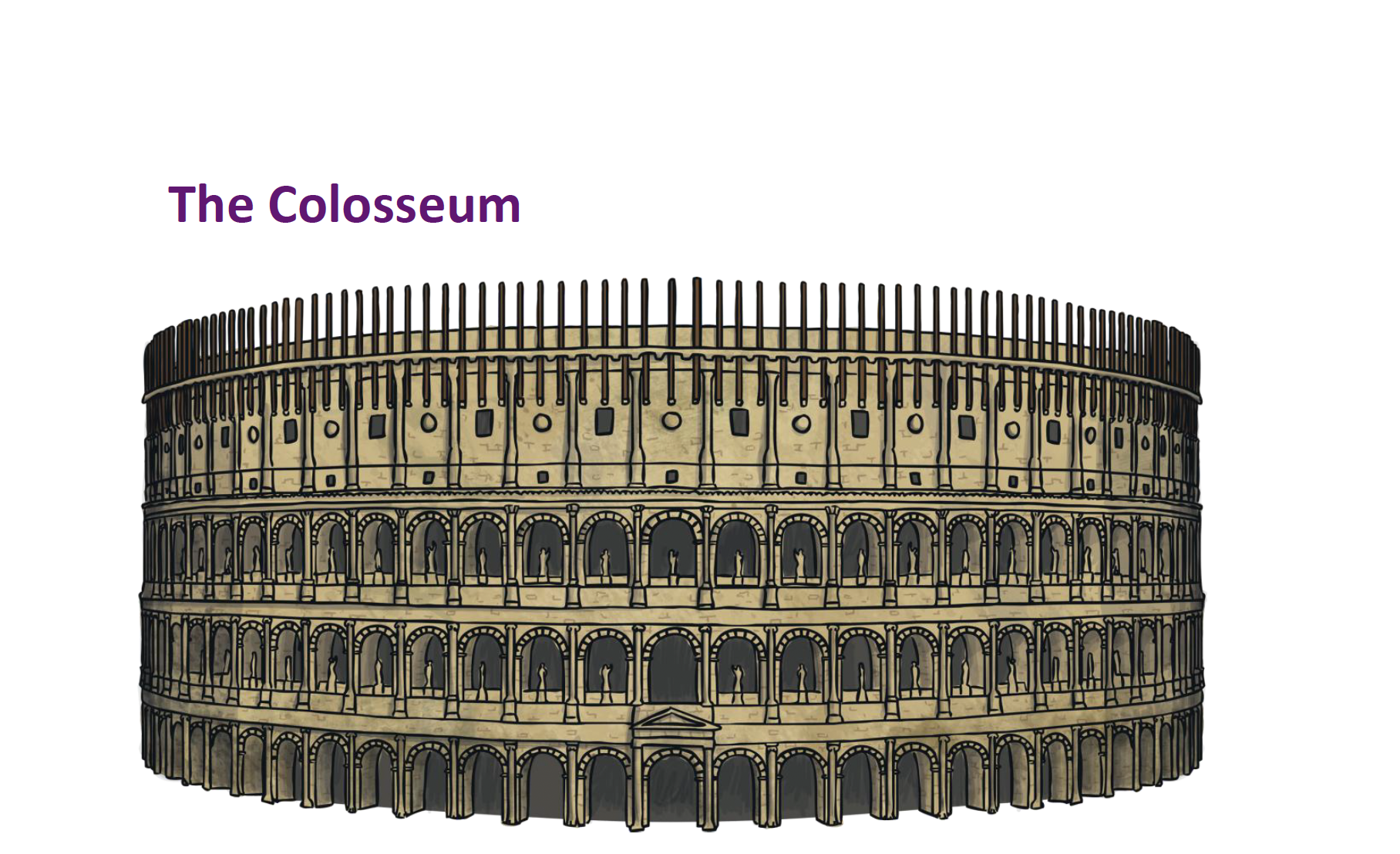
- Show a picture of the Colosseum.
Say: “2,000 years ago, Romans also went to watch events — but they looked very different!”
Activities
Activity 1 – Fact Hunt (10 minutes)
- Read aloud short sections from the fact sheet.
- Ask guided questions:
- “How many people could the Colosseum hold?”
- “What was under the arena floor?”
- “What is the Colosseum used for today?”
Activity 2 – Compare & Discuss (10 minutes)
- On the board, create two columns: Then (Ancient Rome) vs Now (Today).
- Students brainstorm differences between entertainment (gladiators vs football, public executions vs concerts).
Activity 3 – Creative Task (15 minutes)
- Students choose one:
- Draw the Colosseum and label parts (arena, seating, trapdoors).
- Write a mini “tour guide script” as if they were showing tourists around.
- Make a fact card with 3–5 interesting facts.
Wrap-Up & Sharing (10 minutes)
- Volunteers share their drawings, scripts, or fact cards.
- Teacher highlights the importance of preserving cultural heritage.
Evaluation
Informal: Teacher observes contributions during fact hunt and comparison discussion.
Formal Exit Ticket: Students write down:
- One fact they learned about the Colosseum.
- One way it is similar or different from a modern stadium.
Notes
Differentiation
- Support: Provide fact cards with pictures for students who need more scaffolding.
- Challenge: Ask advanced students to research another Roman building (e.g., aqueduct, bathhouse).
Activity 3 – Creative Task (15–20 minutes)
Students choose one of the following three options. Teacher encourages variety so the class produces a mix of drawings, scripts, and fact cards.
Option A – Draw & Label the Colosseum
Task:
- Draw the Colosseum from the outside (round shape, arches) OR the inside (arena with seating).
- Use the fact sheet for accuracy.
- Add at least three labels:
- Arena (where gladiators fought).
- Seating (up to 80,000 people sat here).
- Trapdoors/Underground Tunnels (used for animals and gladiators).
- Arena (where gladiators fought).
- Scaffolding Questions:
- Where would the emperor sit?
- Why do you think Romans built so many arches?
Expected Outcome: A labelled diagram showing that students understand the main parts of the Colosseum.
Option B – Tour Guide Script
Task:
- Imagine you are a tour guide in Rome today.
- Write 5–7 sentences as if you are showing a group of visitors around the Colosseum.
- Include:
- A greeting (“Welcome to the Colosseum, the largest amphitheatre ever built!”)
- At least three facts (size, age, uses in the past, visitor numbers today).
- A closing line (“Thank you for visiting this amazing piece of history!”).
Scaffolding Prompts:
- What would you show first — inside or outside?
- How would you make your tour exciting?
Expected Outcome: A short, persuasive script that demonstrates knowledge while practicing speaking/writing skills.
Option C – Fact Card
Task:
- Create a fact card about the Colosseum.
- Title: “The Colosseum”
- Write 3–5 key facts in bullet points.
- Add one small drawing or symbol (e.g., gladiator helmet, Roman arch).
Scaffolding Prompts:
- Which fact surprised you the most?
- Which fact would make a visitor want to see the Colosseum?
Expected Outcome: A clear and concise fact card, showing selection of key information.
Differentiation
- Support: Provide sentence starters (“The Colosseum was built in … It could hold …”).
- Challenge: Ask advanced students to add a comparison (Colosseum vs modern stadium).
Homework / Follow-Up
- Write a short diary entry as if you were a Roman child visiting the Colosseum for the first time.

Printed materials:
Subjects:
Ages:
Found this resource useful?
Share this lesson plan: